June 1st 2026 Update:
When You Need Low Sugar (NSC) Horse Hay Where Do You Go?
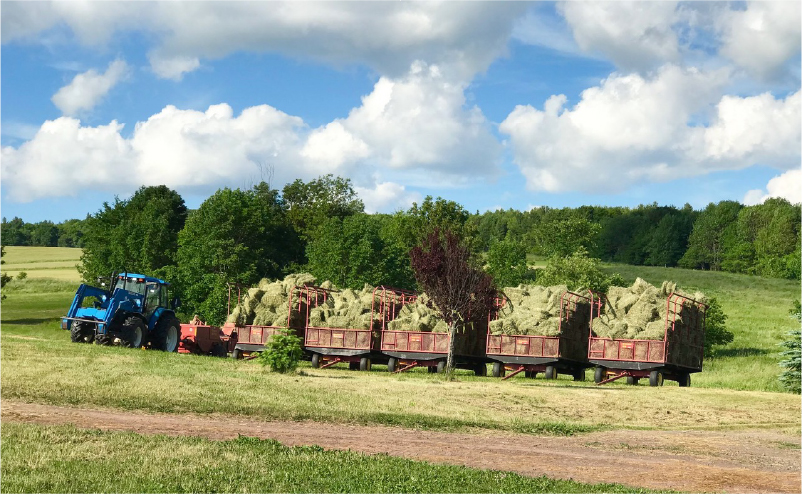
Unfortunately equids suffering from metabolic disease issues seems to be on the increase.
Here at Willowview Hill Farm we are well aware that the hay we produce needs to be more than just organic and free from chemicals and preservatives to be optimized as a healthy forage source for horses. It also needs to address sugar levels.
Over the last few decades we have had many repeat customers who buy our hay not just because it is free from ‘pickle juice’ or other preservatives, free of roundup ready seed and chemical fertilizers/spraying etc., all of which may cause gastric ulcers/hives/skin issues/upper respiratory infections and lower immune systems in equids, but because they appreciate our low sugar (NSC) hay.
Often we are asked if we provide test results on our hay and the answer is we leave our customers to do the testing themselves. Why? Because the results will be used (hopefully) to implement a full nutritional evaluation and program by either a qualified equine nutritional expert/equid veterinary specialist and used as a baseline to build a good dietary protocol for the individual horses. Depending on age, disease, stage of disease, workload and use of the horse , access to pasture, type of pasture (which should also be tested), the dry forage will be incorporated with known values. And when the hay is tested matters in the equation. In hay testing you want to obtain accurate results as of now. Not from last year or last month when the hay has been sitting in a stack or when it was fresh off the field, because over time the results change.
We suggest to our customers that they take a minimum order ( ours is 20 bales) and do their own testing. Regardless of where you buy your hay, testing it yourself also eliminates inaccuracies caused by poor testing practices or sad to say, hay dealers/middlemen or farmers that falsify what hay was actually tested and the results.
There are several ways we manage to keep our hay products on track for good sugar/NSC values. From the type of equipment used to harvest to time of day when hay is cut; from stage of growth when hay is cut; original professional seeding of the fields and the quality of the timothy mix seeds utilized; natural/organic fertilizers to soil testing and evaluation; to where and how the hay is stacked and stored etc. etc.
Be aware that extruded pellet forage comes laden with preservatives. It tells you right there on the label, so buying this style of food is a questionable activity for optimal health care of the equid.
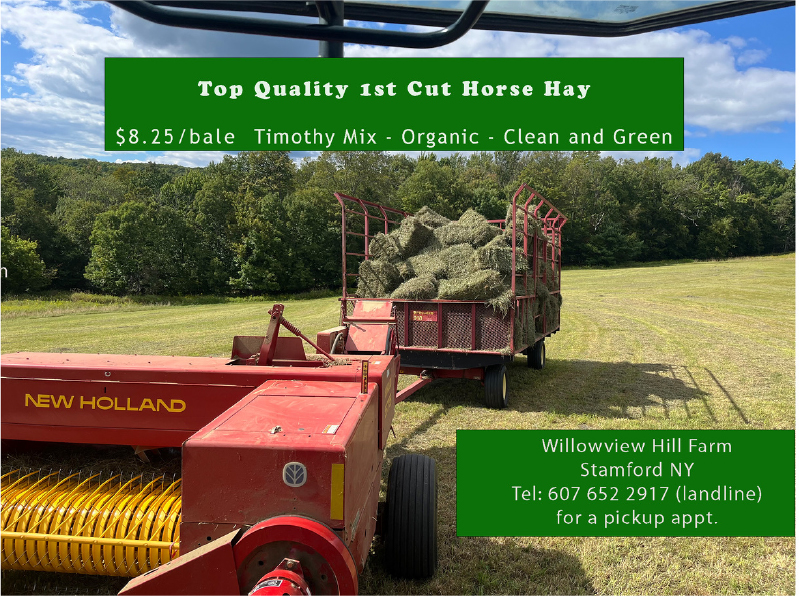
Downside of organic farming is of course the lower yield and the amount of machine time and labor producing hay grown the old-fashioned way takes to harvest. Our high quality clean and green hay cannot be readily compared to the re-baled rounds that find their way into small squares at the dealers’ yards or the dairy farm turned hay producer that cuts and bales hay because it is there. Each to their own. There is plenty of hay business and customers to go around, and our niche is indeed very specialized and to us, special.
So if you have a need for the product we produce reach out. Our hay is good for all horses, all ages and all walks of working life as our equine partners or breeding stock and having a consistent high quality with a known provenance helps both you and your equids, sleep better at night.
August 19th 2026
THE HORSE STUDIO INVITATIONAL
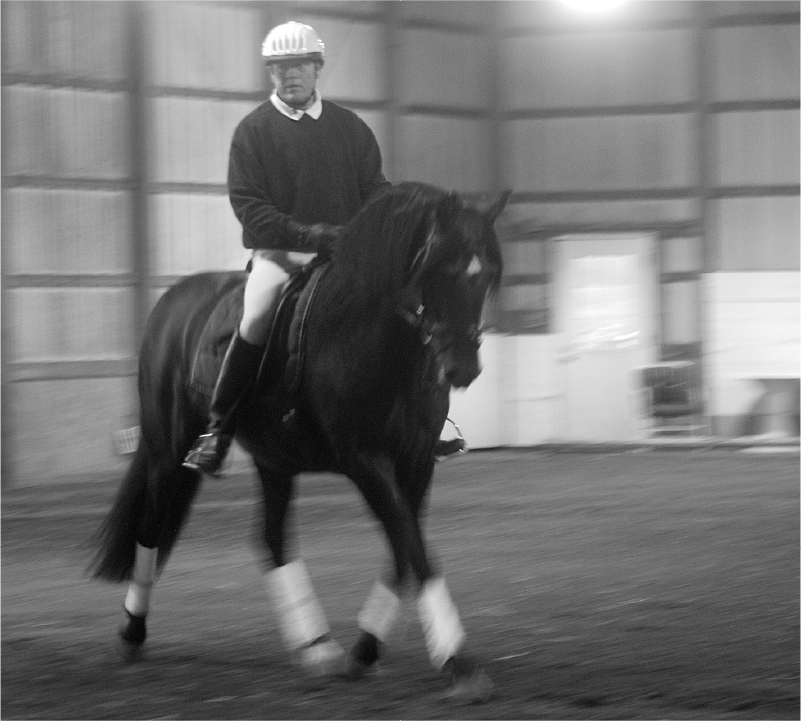
Focus of this clinic is on developing cadence and collection in the dressage horse.
Riders of all levels and horses of all breeds welcome. This is an invitational event hosted by The Horse Studio who will have cameras rolling.
Your chance to ride and be included in the filming of working on cadence and collection with Paul and Nikki Alvin-Smith. Video submission required for acceptance. Please contact WVH for more info.
 Fees & Registration